 Primavera P6,
 Microsoft Project, and
- Other software
Schedule:
(3) : a usually written plan or proposal for future procedure typically indicating the objective proposed, the time and sequence of each operation, and the materials required
(4) : a body of items requiring to be dealt with usually at a particular time or within an indicated period
I am experienced at developing, maintaining, reviewing, and reporting on resource-and-cost-loaded schedules using:
Primavera P6,Microsoft Project, and
I have used Microsoft Project on feasibility studies and smaller projects, while using P6 with EPCM contractors and their experienced, dedicated scheduler(s).
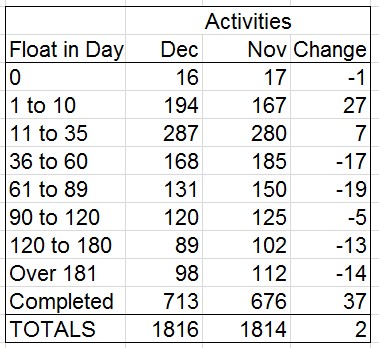
For P6 schedules, I use a Microsoft Access database to read and convert the P6 XER file to a table. Once in the table, the operator can make multiple comparisons (automated using Visual Basic) between the previous schedule or the base line schedule. The comparisons allow for effective change management and automated reporting, such as, the float analysis:
Or, changes by project phase:

Project, as a Microsoft product, has visual basic for applications. To make work with Project efficient and effective, I have an Excel workbook that can read the data from a schedule, and, after updates write new information into the schedule. The workbook can write information to an Outlook task. After assigning the task, the responsible party can update the task and the scheduler will be updated via Outlook on the status. Outlook is an excellent nag system.
The permit schedule displayed in MS Project, below, is on the critical path. (A demonstration that MS Project is not a light weight tool.)
see wikipedia for references to references.
CPM is to construct a model of the project that includes:
1.A list of all activities required,
2.The duration of each activity,
3.The dependencies between the activities, and
4.Logical end points such as milestones or deliverable items.
Using these values, CPM calculates the longest path of planned activities to logical end points or to the end of the project, and the earliest and latest that each activity can start and finish without making the project longer. This process determines which activities are "critical" (i.e., on the longest path) and which have "total float" (i.e., can be delayed without making the project longer).